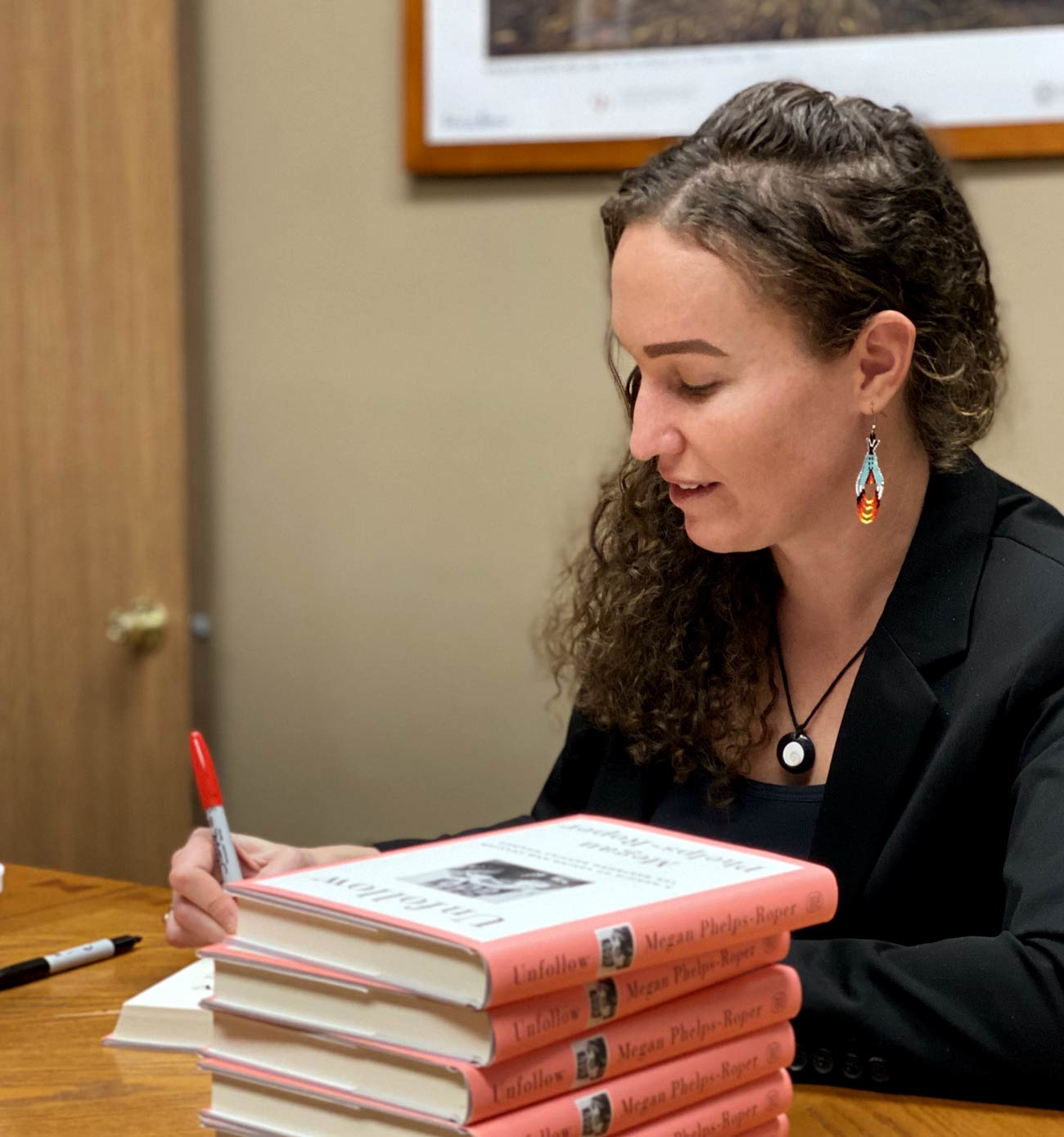
Author Megan Phelps-Roper signing her book Unfollow in 2020. Photo by Ryan Woodard.
Updated March 22, 2022
Life Lessons on Civility
By Ryan Woodard
In her memoir Unfollow: Loving and Leaving the Westboro Baptist Church, Megan Phelps-Roper reveals why she left the Westboro Baptist Church. A former ideological extremist, she articulates her evolving ideology with a reasoned approach to theology, and explains why she relocated to South Dakota, a rural haven of natural beauty, refuge, anonymity and “Midwest nice” for someone who desperately needs it.
But her most profound advice is on civility — how it can be achieved by civil conversation.
Civility May Unite Us
Discourse in 2022 is not often civil. Discussions of public policy, race, religion and politics tend to devolve into vitriol and insults, as people gravitate toward extreme positions and refuse to consider the middle ground. Civility may indeed unite our fractured society if we are patient enough to learn it, and therein lies the problem: our attention spans are short these days.
Civility is a form of humanities-driven intelligence acquired gradually by reading, understanding and embracing other perspectives in literature and life. Taking the idea a step further, the legendary F. Scott Fitzgerald said to live in consideration of others was to live intellectually.
“The test of a first-rate intelligence is the ability to hold two opposed ideas in the mind at the same time, and still retain the ability to function,” he said in his essay “The Crack-Up,” a soliloquy of lessons learned at age 39. Having captured in fewer than 50,000 words the essence of American culture with The Great Gatsby, considered by many as The Great American Novel, Fitzgerald was an expert on human behavior and, by extension, the humanities.
Fitzgerald’s logic dictates that single-minded people who dismiss other opinions have not achieved “first-rate intelligence.” His quote, a vivid distillation of a complex idea, unfolds as a teachable moment, in textbook fashion (no pun intended), in Unfollow. How?
A Transformation
When the book starts, Phelps-Roper is a young member of the dogmatic Westboro Baptist Church who would have scoffed at Fitzgerald’s quote and, had there actually been such a test, failed miserably. Her extremist family forces its viewpoints; she spends her formative years shouting down bereaved families and people with different opinions.
As a protestor, she demonstrates with a large picket sign and a single idea in her head: her family IS right.
Throughout the book, she undergoes the kind of character arc that novelists dream of. Phelps-
Roper hints at her life transformation on the very first page of her memoir with an epigraph suggesting the wisdom of inclusivity from – guess who?
“Reserving judgments is a matter of infinite hope.” – F. Scott Fitzgerald
What changed her mind?
The author endured a heartbreaking series of events — revealed with extraordinary narrative in the book — that gave her perspective beyond her years, leading her, before age 30, to the same conclusion that an emotionally-battered Fitzgerald (the essay was called “The Crack-Up” for a reason) wrote about at 39.
“Doubt causes us to hold a strong position a bit more loosely, such that an acknowledgment of ignorance or error doesn’t crush our sense of self or leave us totally unmoored if our position proves untenable,” she writes. “Certainty is the opposite: It hampers inquiry and hinders growth.”
Enlightened by her experiences and by reading classic books by Fitzgerald, Hemingway and others, she has found a new home in South Dakota, and a new career: author and activist. She has learned that her perspective is one of many — that she is not always right. Nobody is. She changed. Civil conversations can be had in our country if others are also willing to change, to learn humanities-driven critical thinking skills and apply them to their interpersonal relationships and interactions.
Reading and Expanding Attributes
Reading expands perspective, intelligence, empathy. These skills are necessary for a civil conversation, which requires both parties to use “first-rate intelligence” to realize that the other person might be correct.
Through her book, Phelps-Roper encourages civil conversations. She has lived through a monumental change, and her readers encounter the lessons that changed her. These lessons are essential. Because we live in a “civilization,” might it be possible that civility — the ability to relate to others on a personal level, to give context to events and conversations and, therefore, to harness the intelligence of being human — is the most critical skill of all?
This post, reposted with permission of the South Dakota Humanities Council, was written to promote the selection of Unfollow as the 2020 One Book South Dakota. Read more about the One Book program at sdhumanities.org.